
Holt County History
One of 6 counties formed in the Indian Platte Purchase Territory, annexed to the State 1837, Holt County was organized in 1841 and named for State legislator David Rice Holt. The county’s 456 square miles, bounded west and south by the Missouri, east by the Nodaway, include Missouri River flood plain, steep river bluffs, high glacial prairie. The Lewis and Clark Expedition, in 1804, camped near mouth of the Nodaway.
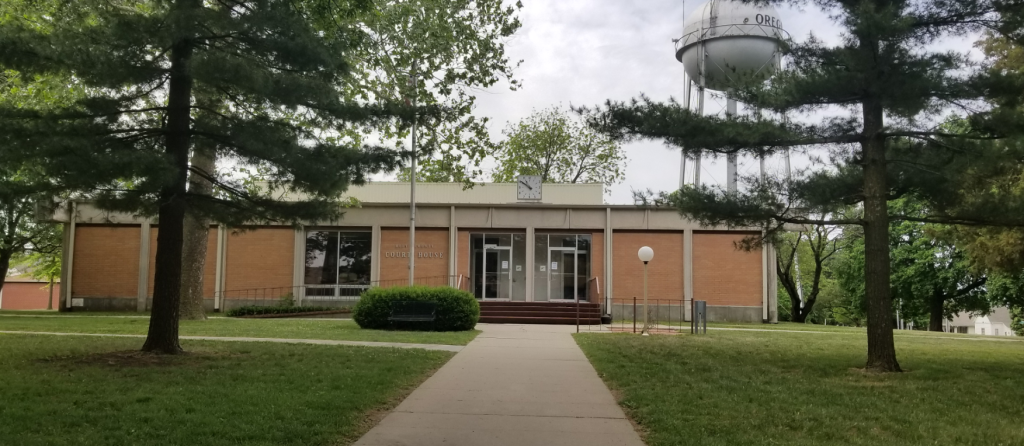
Oregon, the county seat, lying 1093 feet above sea level, laid out 1841, by John A. Williams, Edward Smith, and Travis Finley, was first called Finley. The courthouse is located in a handsome two-and-a-half acre plot. No railroad reached Oregon until a short line, now abandoned, was built in 1908.
A divided county during the Civil War, Holt was subjected to brutal guerrilla raids. Modern growth came with the building of what is now the C.B. & Q. Railroad in the county, north to south, 1869, and northeast to west central, 1879. The county grew as livestock and grain producer and various towns developed as marketing, trading, food processing and shipping centers.
Holt County’s first settlers were Peter and Blank Stephenson, 1838. Pioneers were from Va., Ky., Tenn., Ind., and a large number of Germans located near Craig and Corning in 1839-41. In the 1840’s, Whig Vallley, near Maitland, was settled and Jackson’s Point (for A. P. Jackson), near Mound City, was a stage stop on St. Joseph to Council Bluffs route. Mormons, immigrants, gold seekers of ’49 trekked through the county.
Towns platted in 1857 were Mound City, largest town in the county, and Forest City, once a noted Missouri River port. Bigelow, Corning, Craig were laid out 1868; New Point, Forbes, 1869; Maitland, 1880; Fortescue, 1890.
Holt County State Representative John W. Kelly (1800-58) introduced the resolution leading to 1853 School Law providing first State tax money for public schools. He was one of authors of the law often called the Kelly act. Inventor of Split-log Road Drag, David Ward King (1857-1920) lived in Holt County. Charles C. Moore, a native, served as Lt. Gov. of Idaho, 1919-22, and Gov. 1923-26. In the county are Big Lake State Park and Squaw Creek National Wild Life Refuge.
*As stated on the sign erected by State Historical Society of Missouri and State Highway Commission, 1961, located in front of Holt County Courthouse.